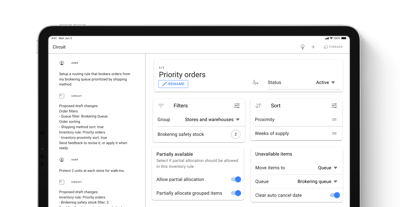
A customer asks why an order has not shipped, but the answer is spread across order screens, inventory views, carrier portals, and reports. The support representative has to find the right records before explaining what happened.
The same screen-hopping slows store teams, operations managers, and seasonal employees who may not know where each piece of information lives. During peak periods, those extra steps delay answers and exception handling.
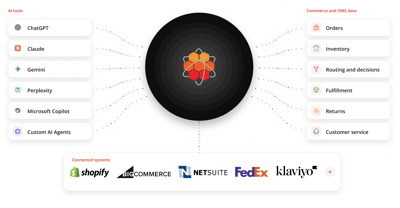
The HotWax Commerce MCP Server gives compatible AI clients controlled access to approved order management system (OMS) data and capabilities. Retail teams can ask operational questions in natural language while HotWax Commerce remains the system of record and control.
Conversational access changes the interface, not the OMS
The Model Context Protocol (MCP) is an open standard for connecting AI clients to business systems. Through MCP, approved AI clients work with the OMS through a defined set of tools and resources.
An AI agent works through the capabilities a retailer makes available. It does not receive unrestricted access to the underlying database. HotWax Commerce continues to govern the data, permissions, and actions exposed through the connection.
This gives users a simpler way to work with live OMS data without requiring them to learn every screen or navigation path.
What retail teams can do with conversational OMS access
The value is practical: faster answers, clearer investigations, and less manual preparation for routine work.
Answer routine order questions faster
Customer service teams regularly need order status, tracking numbers, shipment details, and split-fulfillment context while a customer is waiting.
A connected AI agent can retrieve the approved OMS information relevant to the question and present it in a clear response. The representative spends less time moving between systems and more time resolving the customer's issue.
Help new and seasonal employees become productive sooner
New employees often have to learn where information lives, how different screens connect, and which steps apply to common order and inventory questions.
With conversational access, they can ask a specific question and receive an answer from the OMS context available to their role. This reduces the need to memorize navigation paths before handling routine work, while permissions still limit what they can see or do.
Investigate operational patterns without waiting for a new report
Inventory managers and operations teams may want to know which stores have high split-shipment rates or which locations require further review.
An AI agent can query approved reporting resources and summarize the result in plain language. Teams can identify where to investigate next without requesting a new report for every question or changing routing logic based on incomplete context.
Prepare sensitive actions for human review
Some requests, such as changing a shipping address or cancelling an item, carry more risk than looking up a shipment status.
The agent can prepare the requested action and present the relevant order details, while an authorized user reviews and confirms it before execution. The agent handles the information gathering, but the decision stays with the person responsible for the change.
Match access to operational risk
Looking up an order status and changing a customer's address should not carry the same level of access.
Retailers can define which tools are available by role and require human or manager approval for actions with greater operational or financial impact. A high-value cancellation or a change involving a VIP customer can follow stricter authorization rules than a routine order lookup.
The HotWax Commerce MCP Server acts as a governed bridge between AI clients and the OMS. Retailers can expand access by use case without exposing every capability to every user or agent.
Start with answers, then expand carefully
Conversational retail operations are not about replacing the OMS or bypassing established controls. They give teams a simpler way to retrieve approved context, investigate exceptions, and prepare supported tasks using natural language.
A practical rollout starts with read-only questions. Retailers can then add approval-based actions and automate selected low-risk tasks as governance, permissions, and operating processes mature.
This approach makes AI agents more useful while HotWax Commerce continues to govern data, permissions, approvals, and execution.
Give retail teams a faster path to OMS answers
The HotWax Commerce MCP Server gives compatible AI clients a controlled way to work with approved order, inventory, fulfillment, and reporting context while HotWax Commerce remains the system of record.
* * *
Book a demo to review how your BOPIS orders move from inventory promise to store pickup, and where your current setup may be exposing avoidable gaps.
Frequently asked questions