
Headquarters
175 S Main St Suite 1310,
Salt Lake City, UT 84111



A customer places a buy online pick-up in-store (BOPIS) order. You pick and pack it. You send the notification. Maybe then the order sits in a bag on your hold shelf for a week. Until someone finally pulls it apart and puts the items back.
This happens more often than most retailers want to admit, and it costs real money.
When an order is marked "ready for pickup", the items are physically pulled from your sales floor or stockroom and set aside.
If the customer never comes, those items become stale holds, inventory that is reserved but not generating any revenue. For fast-moving products, this is painful. A pair of sneakers sitting in a bag for 9 days is a pair of sneakers a walk-in customer couldn't buy. That's a lost sale, a carrying cost, and a frustrated store associate who has to unpack and restock everything.
At scale, this adds up fast. A retailer with 50 stores running a 5% non-collection rate could have hundreds of units locked in hold bags at any given time. That's dead inventory and it's entirely preventable.
Before blaming customers, it's worth understanding what actually goes wrong.
A single "ready for pickup" email can land in a promotions folder, get buried under other messages, or simply go unread. If that's the only touchpoint, you've already lost a chunk of your audience.
Most customers also don't know how long you'll hold their order. If the confirmation says "your order is ready" but gives no pickup window, there's no urgency. They mentally file it under "I'll go this weekend" and then don't.
Store hours can quietly derail a pickup too. A customer might plan to swing by after work, only to find the store was already closed. If the notification never mentioned operating hours, they had no way to plan accordingly.
None of these are failures of intent. They're failures of communication, which means they're fixable.
The most important shift you can make is thinking about pickup communication as a sequence, not a one-time event. A solid multi-channel lifecycle looks something like this:
On day zero, when the order is ready, send both an email and an SMS. Include the store address, operating hours, and a clear "reserved until [date and time]" statement. On day 2, send a friendly reminder with the pickup deadline and a simple way for the customer to reach the store. On day 6, send a final note letting them know their hold is expiring soon and that you are happy to help if they need to make other arrangements.
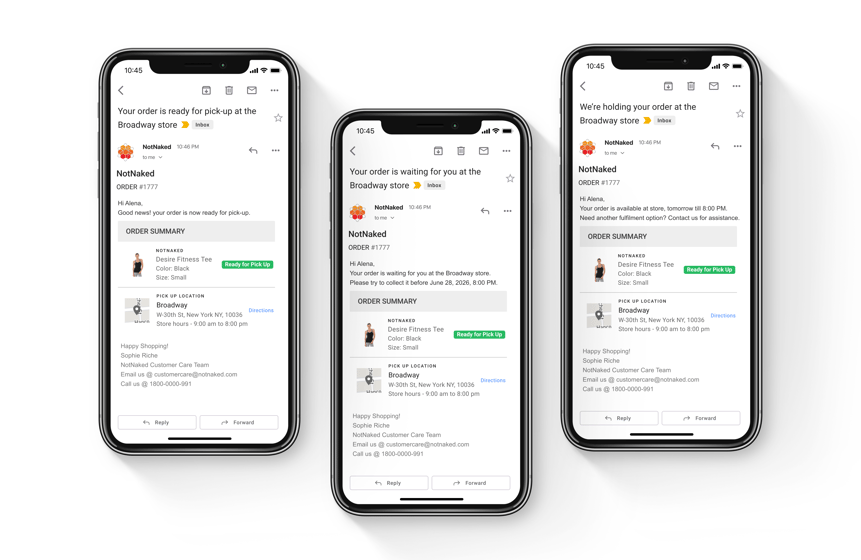 SMS is the key addition here. Email open rates in retail hover around 20-30%. SMS open rates typically exceed 90%. If you're only sending email reminders, a large portion of your customers never sees them. Combining both channels, email for context and detail, and SMS for immediacy dramatically increases the chance of a successful pickup.
One of the simplest and most effective changes you can make is being explicit about the pickup window from the very first notification.
Instead of "Your order is ready for pickup," write: "Your order is ready for pickup. We're holding it for you until Thursday, June 12 at 6:00 PM."
This does two things. First, it creates a concrete deadline, which motivates action far better than vague urgency. Second, it sets a fair expectation so customers aren't surprised if they arrive on day eight and find their order gone.
When the confirmation and reminders all include the same pickup deadline, customers know exactly how long they have to act.
Even with great communication, some orders will still go uncollected. That's why you need a policy that automatically releases held inventory after a defined window, typically 7 days from the "ready" notification, though some categories warrant shorter windows.
When auto-cancel fires, a few things should happen automatically like: the items return to sellable inventory, the customer receives a cancellation notice with clear next steps, and the store associate gets a task to unpack and restock the hold bag.
This keeps your inventory data accurate, your shelves from overflowing, and your customers informed even when things don't go to plan.
Improving pickup communication helps reduce unclaimed orders, freeing inventory faster and reducing the operational burden of storing, tracking, and eventually restocking abandoned pickups.
More importantly, it protects the customer relationship. A customer who gets three thoughtful reminders and a clear deadline comes away with a positive experience, even if they ultimately don't collect. A customer who hears nothing until their order silently disappears probably doesn't come back.
* * *
Failed pickups do not have to turn into stranded inventory and manual store work. When retailers set clear pickup deadlines, send timely reminders, and automate cancellations for unclaimed orders, they make BOPIS operations more reliable for both customers and store teams.
The result is simple: less inventory sitting in the back room, fewer missed sales opportunities, and a smoother pickup experience.
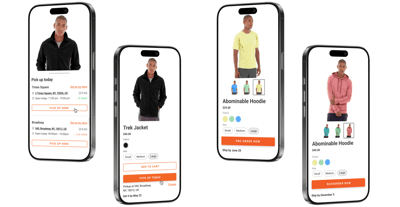
Book a demo to see how HotWax Commerce helps retailers manage pickup reminders, reservation windows, and auto-cancel workflows more effectively.



175 S Main St Suite 1310,
Salt Lake City, UT 84111