
Headquarters
175 S Main St Suite 1310,
Salt Lake City, UT 84111



Every order management system (OMS) vendor now talks about AI. Retailers are asking a more important question: What happens when the AI is wrong?
A chatbot that gives a shopper a clumsy answer is embarrassing. An AI agent that cancels the wrong order, releases a fraud hold, or changes inventory availability creates a different level of risk. It touches revenue, customer promises, and the physical movement of products. Operations and IT leaders are right to question AI claims that skip past governance.
The answer is not to keep AI away from orders. It is to give each agent a defined job, limited access, supervision, and a record of its work.
An AI agent is not simply a chat window added to an OMS. A chat interface answers questions. An agent can investigate an issue, recommend a next step, and prepare work through approved OMS tools.
In order management, an agent can:
Look up an order and assemble its payment status, holds, fulfillment progress, shipment events, and integration status.
Explain a problem in plain language, such as why an order has not shipped or why a routing run skipped a store.
Recommend a next step, such as reviewing a hold, retrying a failed sync, or proposing an approved substitute.
Prepare an action when the retailer has authorized the tool, while execution remains subject to the required permissions and approvals.
Trust depends on how the system treats these activities. Reading, explaining, recommending, and executing do not carry the same risk. A governed agent keeps those boundaries clear.
Order management is unforgiving of small mistakes at scale. One incorrect rule can affect thousands of orders before a team notices. An agent with broad access can create a similar blast radius with less predictable behavior.
Three failure modes matter most:
Confidently wrong explanations: An agent misreads order or inventory data, gives customer service an incorrect answer, and causes the team to act on it.
Overbroad access: An agent can modify orders, jobs, or inventory records outside its intended role. Even a reliable model should not receive permissions it never needs.
Missing accountability: When nobody can identify what changed, which tool was used, or why the change happened, every investigation starts from zero.
These risks are not reasons to reject AI. They are reasons to govern access, actions, and accountability.
Retailers do not need to evaluate AI claims on trust alone. They can ask vendors for specific controls and require disciplined rollout practices. These five guardrails provide a practical baseline.
An agent should interact with the OMS through a defined set of tools, such as looking up an order, summarizing hold reasons, or retrying an approved integration job. It should not have open access to the database or every API.
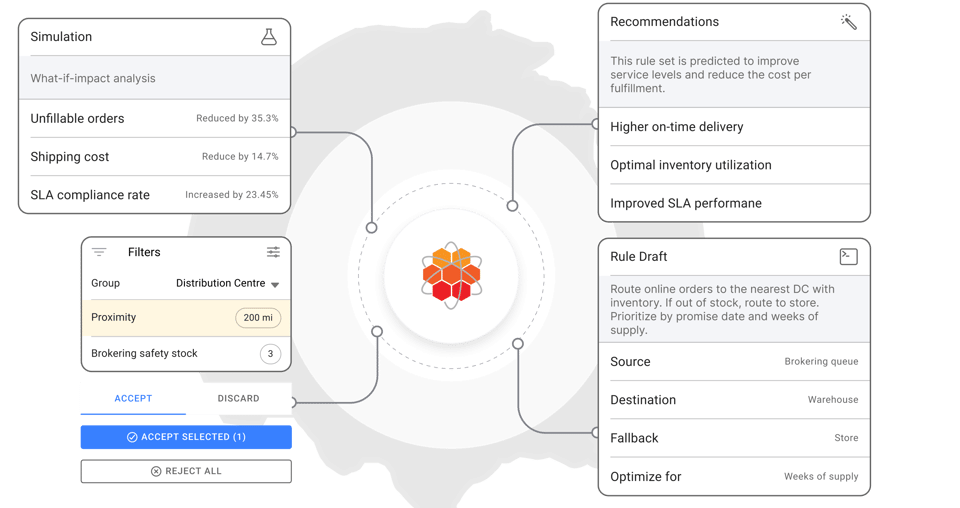
The HotWax Commerce MCP Server follows this model by exposing only the order, inventory, and fulfillment capabilities a retailer approves. If a tool is not available to the agent, the agent cannot use it.
A customer service agent may need to read orders and prepare responses. It does not need to edit routing rules unless told. An operations agent that monitors integration jobs may not need access to customer payment details.
Scope permissions by role, use case, and action. This keeps each agent inside its assigned job, just as access controls do for employees.
Before allowing an agent to act on real orders, run the workflow in a proposal-only phase. The agent recommends or prepares an action, and a person reviews what would happen before anything changes.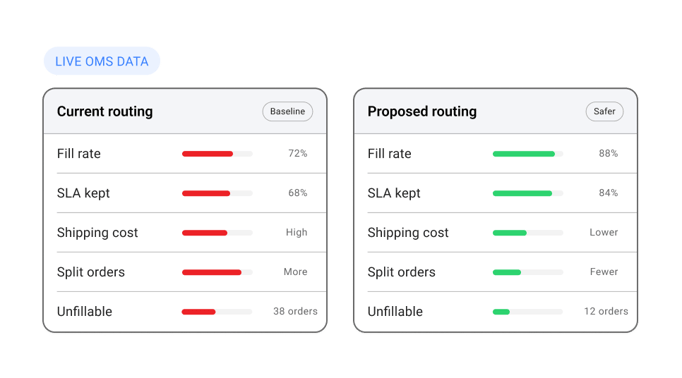 This approach lets the team evaluate decision quality, refine instructions, and identify edge cases without exposing live operations to unnecessary risk.
Some actions should remain behind human review, including canceling an order, changing an address, releasing a fraud hold, or modifying a company-wide setting. The agent can investigate the issue and prepare the work, but an authorized person approves the action.
Approval requirements may change as a retailer gains evidence that a workflow is reliable. Any expansion should be deliberate, limited, and measurable.
Require a record of every lookup, recommendation, approval, and action. The record should identify the agent, the tools it used, the relevant result, and the person who approved a consequential change.
When a decision looks unusual weeks later, the team should be able to reconstruct what happened without relying on guesswork.
Governance makes AI usable. A focused use case makes it valuable. Strong starting points combine high volume, repetitive investigation, and clear next steps.
“Where is my order?” often requires a representative to check order status, holds, fulfillment progress, and carrier events across several screens. An agent can assemble that context and prepare a response while the representative controls what is communicated to the customer.
Fraud reviews, invalid addresses, fulfillment rejections, and substitution decisions follow defined processes. An agent can gather the relevant evidence, explain the issue, and prepare an eligible resolution for review. The operations team spends more time deciding and less time collecting information.
Scheduled jobs, imports, and synchronization processes can fail without an obvious business explanation. With access to approved operational tools, an agent can summarize the failure, identify the affected workflow, and recommend the next investigation step before the issue affects more customers.
In each case, the agent does the investigation while a person remains accountable for the outcome.
If you are evaluating an OMS or adding AI to an existing one, ask:
Which tools can the agent use, and can we review the complete list?
Can we scope access by agent, role, use case, and action?
Can the agent propose changes without executing them?
Which actions require human approval, and can we configure those requirements?
What activity is recorded, and who can review that history?
What happens when the agent lacks enough information? Does it stop and escalate, or does it guess?
An OMS vendor with a governed approach should answer these questions directly. Vague claims about enterprise AI are also an answer.
Retail operations teams do not give a new employee access to every routing rule on the first day. A new hire begins with limited access, completes supervised work, earns broader responsibility, and remains accountable for every action.
AI agents need the same progression because orders are real. HotWax Commerce applies this governed approach through the HotWax Commerce MCP Server, which gives agents scoped access to approved OMS capabilities. Sensitive actions remain behind retailer-defined permissions, approvals, and human review.
That foundation lets retailers begin with low-risk assistance and expand an agent's responsibilities only when the workflow has earned their trust.
* * *
Explore how the HotWax Commerce MCP Server connects AI agents to live OMS data. Book a demo to discuss the first governed workflow for your operations team.






175 S Main St Suite 1310,
Salt Lake City, UT 84111