Changing order routing rules during peak season can create problems that spread quickly across the network.
One rule change can overload a flagship store, drain inventory from the wrong location, or push orders into a constrained warehouse.
Retailers usually understand the risk. What they often lack is a safe way to test a new routing strategy before it starts affecting live orders. That is why many teams still rely on guesswork, staging environments, developer support, or a technical configuration cycle to make operational changes.
Why staging environments are not enough
Most staging environments cannot reproduce live order velocity, real inventory contention, carrier constraints, or store-level demand. A routing rule that looks fine in test data can behave very differently during a weekend promotion, a weather disruption, or a viral demand spike.
That gap is what makes routing changes expensive. Teams do not need a prettier testing screen. They need a way to evaluate routing logic against production conditions without touching production itself.
What a routing simulation engine actually does
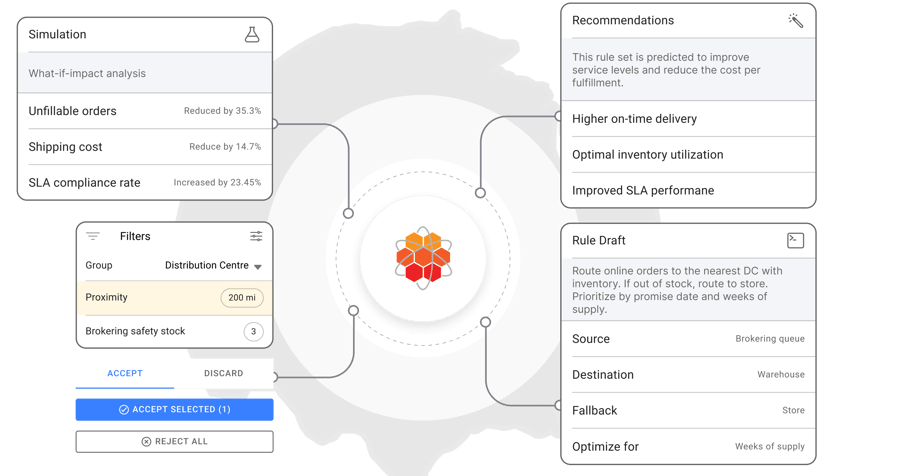
A routing simulation engine gives business users a zero-impact way to test routing changes before deployment. Instead of relying on mock data, it evaluates proposed logic against live operational data so teams can see how orders would flow if the rule were activated.
That means operators can validate whether a new rule would increase split shipments or shift too much volume into one store. They get the answer before the rule goes live, not after customer service tickets start piling up.
Six routing decisions retailers should simulate before deployment
The value of simulation becomes clearest when teams use it to test specific operational decisions, not abstract routing theory. These are some of the high impact routing changes retailers can validate before rollout.
Flagship store protection
If you prioritize ship-from-store to clear aged inventory, the first question is which stores will absorb the volume. A simulation can reveal when a seemingly smart rule would overwhelm a flagship location that is already serving heavy walk-in traffic. Teams can then cap daily order volume or lower that store's routing priority before the floor feels the impact.
Regional 3PL or warehouse disruptions
When a weather event, carrier issue, or labor shortage hits one node, retailers need to reroute volume quickly. A simulation helps teams test the diversion path first, so they can confirm the backup nodes can absorb the load without breaking pickup promises or creating a second bottleneck elsewhere.
Major sales events
Flash sales and peak trading periods often require temporary routing logic. Retailers may want to open more stores for fulfillment, protect key inventory pools, or shift volume toward speed over margin. Simulation shows whether the short-term rule actually clears backlog or simply moves pressure from one part of the network to another.
Viral demand spikes
When one product suddenly surges in one region, teams often need a fast temporary routing adjustment. A simulation helps confirm whether that rule protects standard delivery times, preserves inventory for other channels, and avoids starving nearby stores of high-demand stock.
Reducing split shipments
A rule designed to reduce split shipments can look great on paper but quietly increase delivery distance and shipping costs. Simulation makes that trade-off visible. Teams can see whether lower parcel count actually improves profitability or just moves cost from packaging into transportation.
Safety stock changes
When retailers raise or lower safety stock, they are changing more than inventory exposure. They are also changing which nodes become attractive for fulfillment. Simulation helps teams test whether a new buffer protects against oversells without unnecessarily shrinking sellable inventory or pushing orders to more distant or higher-cost locations.
How HotWax Commerce simulates routing with live OMS context
HotWax Commerce's simulation engine executes proposed routing rules against live production data without affecting operational transactions. Teams can see how orders would be routed under the proposed logic before the rule is deployed.
Because HotWax Commerce already manages inventory availability, safety stock, facility eligibility and priority, fulfillment methods, and routing logic, the simulation uses the same operational context that shapes live order routing. Teams can compare proposed outcomes, validate temporary promotional rules, test rerouting during disruptions, and confirm inventory protection or capacity rules before rollout. Business users can experiment faster without depending on developer support for every change.
Simulate first, then deploy with confidence
Order routing optimization should not depend on trial and error in live operations. The more complex the network becomes, the more important it is to test routing logic before it affects customers, stores, or warehouse teams.
Routing teams should not have to choose between moving quickly and protecting live fulfillment operations. Simulation gives them a way to evaluate the impact first, refine the logic, and deploy the change with clearer expectations.
* * *
HotWax Commerce helps retailers model proposed routing changes against live production data without affecting operational transactions. Teams can compare routing outcomes, refine the logic, and deploy changes with greater confidence.
Book a demo to see how the simulation engine can help your team test routing changes before they go live.