
Headquarters
175 S Main St Suite 1310,
Salt Lake City, UT 84111



On Monday, you change one order routing rule. The goal is straightforward: prioritize the closest eligible store and reduce shipping distance. The logic looks sensible, so the change goes live.
By Wednesday, several stores are carrying more online orders than their teams can comfortably fulfill. Pick queues are growing, inventory is being consumed faster than expected, and orders that looked easy to route are becoming exceptions.
This is why teams need to test order routing rules as changes to the entire fulfillment network, not as isolated lines of logic.
The case for simulating routing rules is already clear. The practical question is how to structure a test that produces a decision your operations team can trust.
A useful routing test begins with a specific decision. “Will this rule work?” is too broad. Define the operating change you are considering and the outcome that would make it acceptable.
For example, the proposed change may be to lower brokering safety stock for a weekend promotion. The objective could be to route more orders without pushing participating stores above their configured order limits. Another test might add stores to a fulfillment group while keeping unfillable orders from increasing.
Write the decision and its guardrails before creating variants. This prevents the team from selecting a result simply because one metric improved.
A simple test brief states the routing change being considered, the order population and time period being evaluated, and the primary outcome, such as brokered item count or unfillable rate. It also names the guardrails, such as store workload, inventory exposure, or delivery distance, and the person responsible for approving the change.
This turns simulation into an approval tool rather than an open-ended experiment.
The baseline should represent the routing policy that is active today. Run it over a defined order scope with the same inventory and facility context you will use for every proposed variant.
Record the scope with the result. Note the product store, routing group, date range or queue selection, the data freshness, and whether the run used the full population or a bounded sample. A comparison loses value when one option is tested against a different order mix.
The baseline also gives the team a reference point for metrics that may already be imperfect. If some orders are unfillable under the current policy, the test should show whether a variant improves that result, makes it worse, or simply moves the problem to another queue.
Save the baseline instead of rerunning it from memory. The goal is to make later reviews repeatable, especially when operations, implementation, and store teams are evaluating the same proposal.
A routing policy contains several interacting choices: facility eligibility, proximity, safety stock, inventory sorting, capacity limits, assignment mode, rule sequence, and fallback actions. Changing several at once may improve the headline result while making it impossible to explain why.
Create focused variants that each represent a business choice. For a closest-store strategy, the baseline is the current routing policy. Variant A prioritizes proximity without changing capacity limits, Variant B prioritizes proximity and also caps daily store volume, and Variant C prioritizes proximity only within a selected facility group.
Each variant should have a clear name and a short explanation. Reviewers should be able to understand the policy difference without opening every rule.
Once the individual effects are understood, the team can test a combined option. This sequence makes it easier to trace an outcome back to the change that produced it.
Use the same order scope, inventory context, and facility network for the baseline and every variant. If inventory consumption modeling is enabled, keep it consistent so earlier simulated assignments affect what later orders can use in the same way across runs.
A bounded sample can be useful when the live queue is large, but the sample size needs to remain visible in the review. A result based on a limited sample should not be presented as if it covered the full production population.
Do not treat one successful run as proof for every operating condition. A policy intended for a promotion should be tested against a representative promotional order mix. A rule meant to protect stores during peak traffic should be evaluated with the relevant facility limits and inventory conditions.
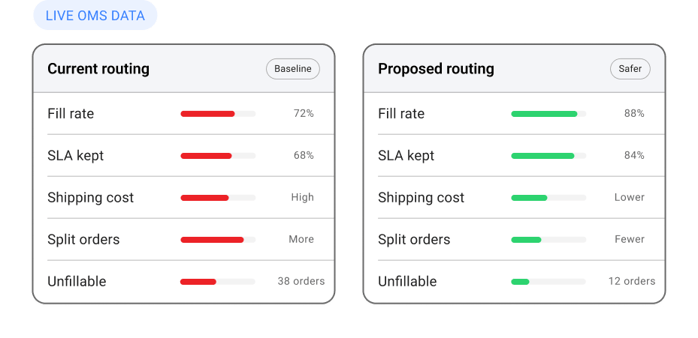
The objective is not to predict every future order. It is to compare proposed policies under the same realistic conditions and expose material tradeoffs before the change reaches live fulfillment.
Start with the network summary. Compare attempted, brokered, queued, and unfillable item counts. This shows whether the proposed policy improves the primary outcome or simply changes where unresolved work appears.
Next, review facility workload. Identify which stores and warehouses gained or lost assignments, whether demand became concentrated in one region, and whether any location moved close to its configured order limit. A higher brokered count is not necessarily better if it creates an operational bottleneck.
Finally, inspect order-level explanations. Look at final reasons, assignments, and rule attempts for orders whose outcomes changed. This is where the team can confirm whether the result came from the intended rule or from an unexpected fall-through, filter, or inventory condition.
The three layers answer different questions. The network summary shows whether the policy improved the overall result, facility workload shows where the work moved, and the order and rule detail shows why specific outcomes changed.
Review them together. Aggregate metrics without explanations are hard to trust, while individual order traces do not reveal the network effect.
Testing a single order and simulating a routing policy are related, but they solve different problems.
Order-level Test Drive is useful when a team needs to understand why one order qualified for a route, which rule matched, which facility was selected, or why the current configuration produced a specific result.
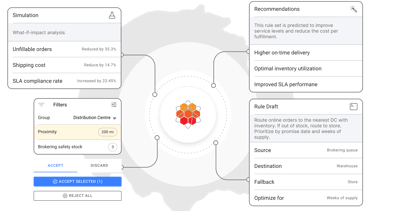
Routing simulation evaluates the broader effect of a proposed policy over a bounded group of orders. It compares baseline and variant outcomes, facility workload, queue results, and rule behavior without changing production orders, inventory, reservations, facility order counts, or live routing configuration.
Use order-level testing to diagnose a known assignment. Use simulation when deciding whether a change is safe for the wider network.
A routing test should end with a decision record, not just a chart. Capture the baseline, the chosen variant, the order scope, the important metric changes, the guardrails reviewed, and any risks that remain.
The current HotWax Commerce Routing Simulation flow keeps this review separate from production changes. A tested variation is not automatically applied to live routing. After approval, the corresponding configuration change is made through the live routing workflow.
That separation creates a deliberate checkpoint. Operations can confirm the business outcome, implementation teams can verify the configuration, and store leaders can review workload changes before customer orders are affected.
HotWax Commerce provides configurable order routing for online orders allocated across stores and warehouses. Routing policies can account for shipping method, proximity, inventory availability, safety stock, facility participation, fulfillment capacity, and order limits.
Routing Simulation adds an isolated what-if environment for comparing the current baseline with edited routing variations. Results can be saved and reviewed through network summaries, facility workload, final reasons, assignments, and rule attempts.
Because the simulation uses production-shaped OMS data in isolated storage, teams can evaluate proposed changes without mutating live fulfillment data or configuration. The result is evidence for an operational decision, not an automatic production deployment.
Define the decision, success metric, and guardrails before creating a routing variant.
Use one reproducible baseline and keep the order scope consistent across comparisons.
Change one meaningful variable at a time so the outcome remains explainable.
Review network totals, facility workload, and order-level reasons together.
Use Test Drive for a specific order and Routing Simulation for network-level policy decisions.
A routing rule can look correct and still create the wrong operating result at scale. Before changing a live policy, run the current baseline and proposed variants under the same conditions, review the tradeoffs, and document the approval.
* * *
See how HotWax Commerce supports configurable order routing and routing simulation for distributed fulfillment networks. Book a demo and run the comparison on your own order history.






175 S Main St Suite 1310,
Salt Lake City, UT 84111