An order is delayed but the reason is not obvious. A customer service representative checks the order management system, warehouse updates, inventory records, and carrier status, while the operations team works through a growing exception queue.
Often, the problem is not missing data. The relevant context is spread across systems and workflows, making it slow to understand what happened and decide what to do next.
AI agents can reduce that investigation time when they work with live order management system (OMS) context and governed tools. Instead of acting on their own, they can explain an exception, surface resolution options, and prepare an approved action for a person to review.
What an AI agent needs from an OMS
A language model alone cannot reliably support order operations. It needs current order records, inventory availability, shipment status, routing decisions, facility responses, and the business rules that determine which actions are allowed.
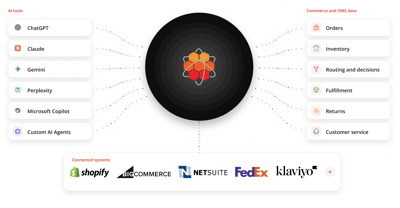
The OMS provides that operating foundation. The HotWax Commerce MCP Server uses the Model Context Protocol (MCP) to give AI agents scoped access to approved order, inventory, and fulfillment capabilities. A retailer can let an agent read an order or explain an exception while keeping sensitive actions behind permissions, approvals, and human review.
Together, live OMS context and governed access make AI agents practical for day-to-day order operations.
Five order management workflows AI agents can support
Find the cause of stuck orders faster
An order can stop moving because it is waiting for inventory, blocked by a hold, rejected by a fulfillment location, excluded by a routing rule, or missing a response from another system. Reconstructing that history across several screens takes time and can lead to inconsistent decisions.
A connected agent can review the order timeline, reservations, routing outcomes, fulfillment status, facility responses, and related system events. It can distinguish an inventory delay from a hold, rejection, or integration issue, then summarize the likely cause and recommend the next operator step.
Operations teams get a consistent starting point for resolving the exception without repeating the same manual investigation for every order.
Prioritize exceptions by business impact
A single queue may contain delayed, unallocated, rejected, and backordered orders with very different levels of urgency. Working through that queue by age alone can leave high-impact exceptions unresolved.
An agent can organize the workload using retailer-defined criteria such as the promised delivery date, order value, customer priority, affected units, and fulfillment stage. It can bring orders most likely to miss a promise or require immediate attention to the top while grouping similar issues for faster review.
The operations team still defines the priority rules and chooses the action. The agent turns a flat exception list into a clearer, more useful workload.
Explain routing decisions clearly
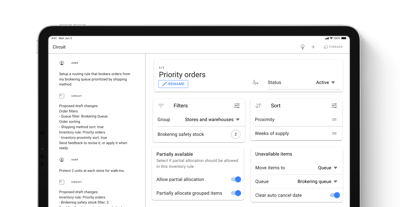
Routine allocation decisions belong in the OMS. The HotWax Commerce order routing engine evaluates inventory, proximity, fulfillment capacity, delivery requirements, split conditions, and retailer-defined rules to select the right fulfillment location.
The agent becomes useful when an exception needs human attention. It can explain why a location was selected or excluded, show which alternatives remain eligible, and summarize the effect of a change on delivery timing, fulfillment capacity, or split shipments. When an approved tool is available, it can also prepare a rerouting or rebrokering action for review.
This gives operators a faster way to understand routing outcomes without handing the allocation decision to an unrestricted agent.
Spot inventory risks before they affect more orders
Inventory problems often appear first as a pattern of exceptions. A store may repeatedly reject the same SKU, reservation records may conflict with available inventory, or pre-orders may approach the quantity expected on inbound purchase orders.
With access to order exception history, inventory records, reservations, and inbound supply data, an agent can flag recurring issues by SKU or fulfillment location. It can explain the pattern and recommend a targeted investigation, such as reviewing a receipt, scheduling a cycle count, or checking pre-order allocation.
Inventory and operations teams can address the underlying problem before it creates more backorders, overselling, or missed promise dates. Inventory changes remain with the authorized people and workflows responsible for validating the physical stock.
Give customer service teams clear resolution options
A customer asking about a delayed order needs more than the latest tracking status. The customer service representative needs to understand the cause, know which options are still available, and act within the retailer's policy.
An agent can bring together the order status, fulfillment progress, available inventory, shipment information, and approved service policies. It can explain the issue and prepare eligible options such as waiting for the original shipment, splitting the order, rerouting an item, or canceling an eligible line.
The representative reviews the recommendation, chooses the appropriate response, and communicates it to the customer. This reduces screen-hopping while keeping the final decision with the service team.
Match permissions to the risk of the action
Not every agent task carries the same risk. Reading an order or summarizing an exception is different from canceling an item, changing a routing decision, or adjusting inventory.
Retailers can separate read-only tools from write-enabled tools, then apply roles, permissions, approval steps, and human review to sensitive actions. An agent may be allowed to explain a problem, recommend a resolution, or prepare a change without being allowed to execute it automatically.
This creates a controlled path from insight to action. Teams can begin with low-risk assistance and expand the agent's responsibilities only after the workflow, permissions, and results have been validated.
Start with one workflow and one measurable outcome
Broad AI initiatives often stall because they begin with a technology goal instead of a specific operational problem. A better starting point is one high-volume workflow with clear data, defined permissions, and an outcome the team can measure.
For an order exception use case, that measure could be the time required to identify the cause, the number of manual touches, the time to resolution, or the number of cancellations prevented. Once the workflow performs reliably under clear controls, retailers can extend the same approach to other order management problems.
* * *
HotWax Commerce brings together the order, inventory, routing, and fulfillment context that agents need to support practical order management workflows. The HotWax Commerce MCP Server provides governed access to that live context, helping teams get faster answers and prepare approved actions without giving agents unrestricted control.
Book a demo to see how AI agents can work with live HotWax Commerce data on your own order flows.