
Headquarters
175 S Main St Suite 1310,
Salt Lake City, UT 84111


A promotion goes live, demand shifts toward the East Coast, and the Times Square flagship starts receiving more ship-from-store orders than it can process. The operations team knows the routing strategy needs attention, but first they need to understand what the engine is doing and why.
That investigation can involve the order, eligible facilities, inventory availability, safety stock, facility priority, and fulfillment capacity. While the team moves between screens, new orders continue down the same path. The same screen-hopping slows customer service, store teams, and seasonal employees who need a quick answer about an order and may not know where each piece of information lives.
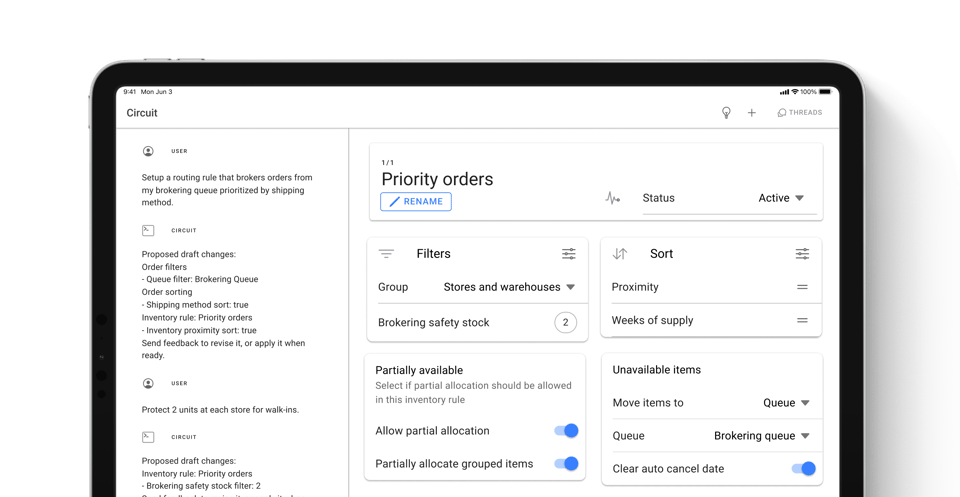
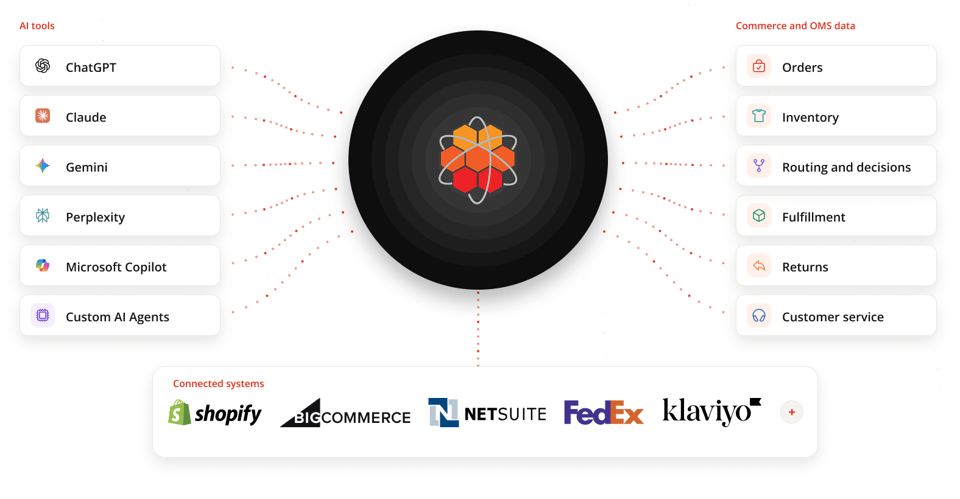
HotWax Commerce gives retailers two complementary ways to bring AI into this work. The MCP Server gives approved AI agents a governed connection to live order, inventory, fulfillment, and reporting capabilities in the OMS, so teams can ask operational questions in natural language. Circuit, HotWax’s AI routing agent, provides a purpose-built experience for drafting brokering rules, simulating changes, and reviewing AI-backed recommendations before they go live.
Order routing depends on conditions that rarely stay fixed. Inventory moves, stores reach their daily order limits, safety stock protects local demand, and shipping windows close.
HotWax Commerce already lets retailers configure omnichannel order routing around factors such as inventory health, proximity, fulfillment capacity, order priority, and split conditions. The challenge during a disruption is often not a lack of routing logic. It is finding which rule or constraint shaped the outcome quickly enough to respond.
AI can shorten that investigation only when it can work with the same current data and approved capabilities used by the OMS.
The Model Context Protocol (MCP) is an open standard that lets AI applications work with external systems through defined tools. The HotWax Commerce MCP Server applies that model to order management, so retailers decide which OMS capabilities an agent can use.
The connection is deliberately bounded. Looking up an order may be a read-only tool. Preparing or applying a routing change is a different capability and can require approval. If a routing capability has not been exposed as a tool, the agent cannot use it.
The MCP Server and Circuit solve different parts of the problem. The MCP Server controls how approved AI agents reach OMS capabilities. Circuit focuses the AI experience on routing work, including rule drafting, simulation, and recommendations. In both cases, the OMS remains the system of record and the routing engine remains the decision engine.
Conversational access changes the interface, not the OMS. Teams get faster answers, clearer investigations, and less manual preparation for routine work, without learning every screen or navigation path.
Customer service teams regularly need order status, tracking numbers, shipment details, and split-fulfillment context while a customer is waiting. A connected AI agent can retrieve the approved OMS information relevant to the question and present it in a clear response, so the representative spends less time moving between systems and more time resolving the issue.
New employees can ask a specific question and receive an answer from the OMS context available to their role. They need fewer memorized navigation paths before handling routine order and inventory questions, while permissions still limit what they can see or do.
Inventory managers and operations teams may want to know which stores have high split-shipment rates or which locations need further review. An AI agent can query approved reporting resources and summarize the result in plain language, which helps teams decide where to investigate next without requesting a new report for every question.
Some requests, such as changing a shipping address or canceling an item, carry more risk than looking up a shipment status. The agent can prepare the requested action and present the relevant order details, while an authorized user reviews and confirms it before execution.
When an order routes to a surprising location, an approved agent can gather the available order and fulfillment context behind the assignment. A team might ask, “Why did order 10452 route to the Chicago store instead of the nearest warehouse?”
The answer can compare the conditions the available tools expose, such as inventory, safety stock, facility eligibility, priority, capacity, and split rules. That helps the team distinguish a valid decision from a configuration issue.
Circuit reviews routing groups, order filters, sorting logic, and inventory rules in context. Teams can see which rules are active, which orders they select, and where the logic may need adjustment.
Circuit can also monitor order, inventory, capacity, and cost signals for routing opportunities, then present the recommendation, the reason behind it, and the expected operational impact for review.
During a promotion or disruption, an operations team may want to protect a flagship store, prioritize a regional facility group, or pause a constrained location. The team can describe that outcome in plain language.
Circuit turns the request into an editable brokering rule draft. Operations teams can review and approve the proposed logic instead of relying on technical teams to configure every rule.
Before a new rule reaches live fulfillment, Circuit can compare the proposal against live OMS data and show the likely effect on orders, stores, cost, and delivery promises. Teams can test peak-season or disruption scenarios without making customers the test case.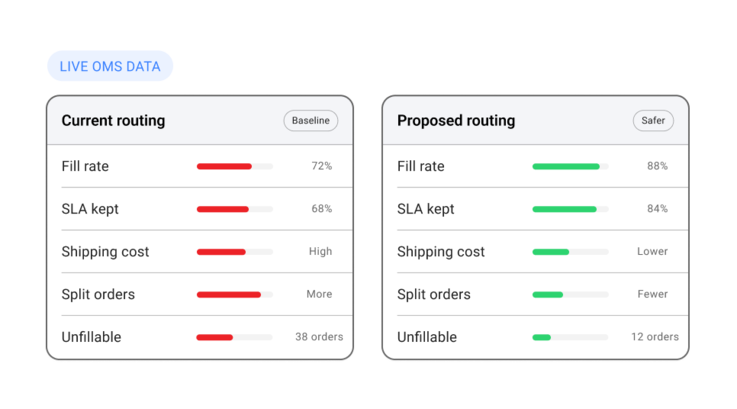
Explaining a decision carries less risk than changing logic that can affect thousands of orders. Retailers should grant agents the smallest useful set of tools and treat read-only and mutating capabilities differently.
Within Circuit, high-impact changes stay approval-based, while low-risk updates can run within defined guardrails. The MCP Server provides the broader control boundary: agents use explicit tools, OMS permissions still apply, and teams can inspect what the agent called instead of treating the answer as a black box.
The same principle applies outside routing. Retailers can define which tools are available by role and require human or manager approval for actions with greater operational or financial impact. A high-value cancellation or a change involving a VIP customer can follow stricter authorization rules than a routine order lookup.
A practical rollout starts with read-only questions. Retailers can then add approval-based actions and automate selected low-risk tasks as governance, permissions, and operating processes mature.
AI-assisted operations are most useful when they reduce the distance between an operational question and a governed response. Teams spend less time reconstructing context, see the constraint affecting an order or group of orders, and decide what to change with better information.
The routing engine still decides where orders go, and HotWax Commerce remains the system of record. The MCP Server makes approved order, inventory, fulfillment, reporting, and routing context available to the AI tools a retailer chooses, within the controls the retailer sets.
AI agents need live OMS context to explain routing decisions. Static exports and generic documentation cannot show what influenced an order at that moment.
The MCP Server exposes only the tools a retailer approves. It does not give an agent open access to the OMS.
Customer service, store, and operations teams can ask order, inventory, and reporting questions in natural language, within the tools approved for their role.
Circuit turns natural-language routing goals into editable brokering rule drafts, tests proposed changes against live OMS data, and keeps high-impact updates approval-based.
Sensitive changes can stay behind existing permissions, approvals, and human review.
* * *
See how AI-powered order routing works with Circuit, or book a demo to explore how governed AI can support your own order flows.




175 S Main St Suite 1310,
Salt Lake City, UT 84111